In Praise of Robert Frank

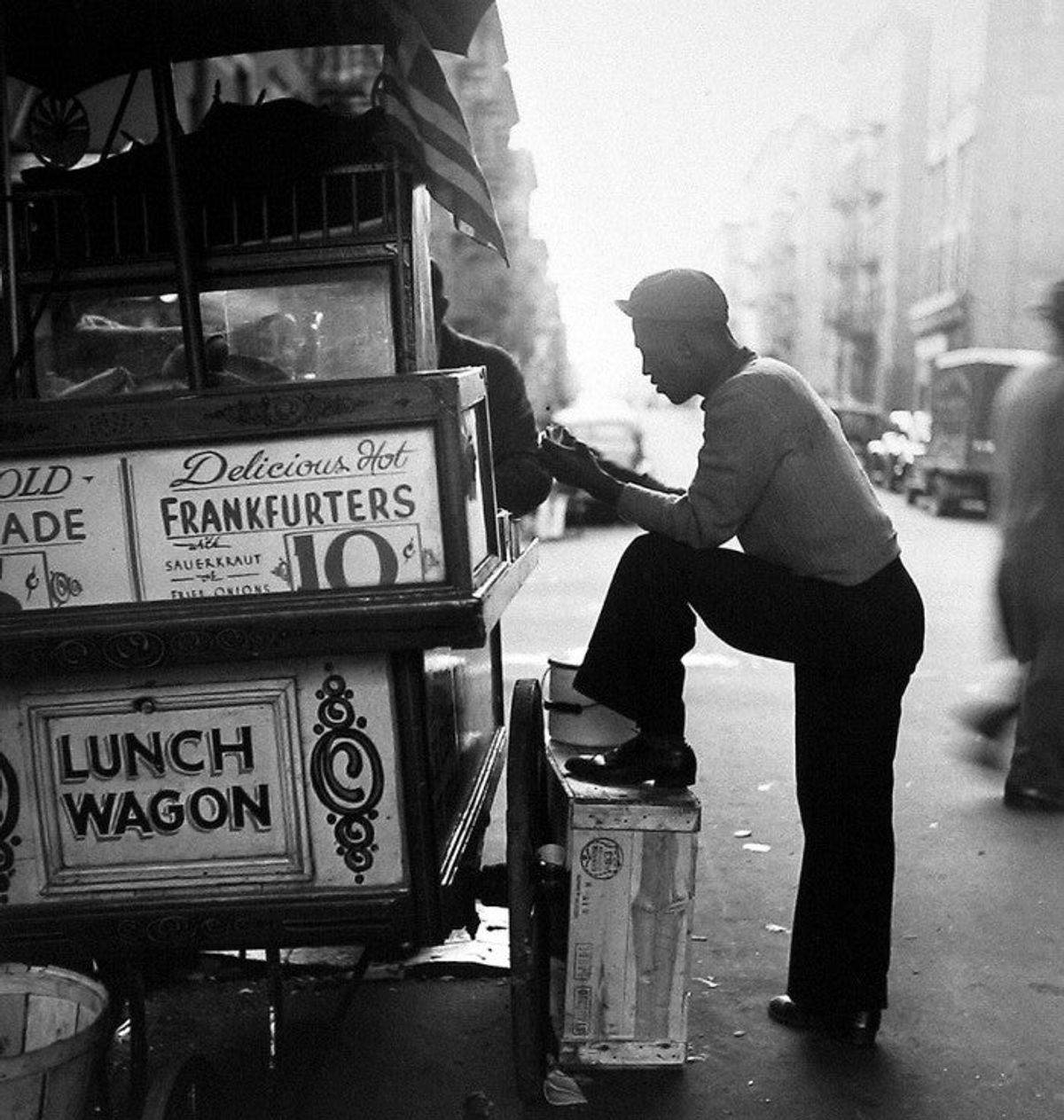
Ah, now this looks like it’s worth your time. Nicholas Dawidoff’s :
Sixty years ago, at the height of his powers, Frank left New York in a secondhand Ford and began the epic yearlong road trip that would become ‘‘The Americans,’’ a photographic survey of the inner life of the country that Peter Schjeldahl, art critic at The New Yorker, considers ‘‘one of the basic American masterpieces of any medium.’’ Frank hoped to express the emotional rhythms of the United States, to portray underlying realities and misgivings — how it felt to be wealthy, to be poor, to be in love, to be alone, to be young or old, to be black or white, to live along a country road or to walk a crowded sidewalk, to be overworked or sleeping in parks, to be a swaggering Southern couple or to be young and gay in New York, to be politicking or at prayer.
The book begins with a white woman at her window hidden behind a flag. That announcement — here are the American unseen — the Harvard photography historian Robin Kelsey likens to the splash of snare drum at the beginning of Bob Dylan’s “Like a Rolling Stone”: ‘‘It flaps you right away.’’ The images that follow — a smoking industrial landscape in Butte, Mont.; a black nurse holding a porcelain-white baby or an unwatched black infant rolling off its blanket on the floor of a bar in South Carolina — were all different jolts of the same current. That is the miracle of great socially committed art: It addresses our sources of deepest unease, helps us to confront what we cannot organize or explain by making all of it unforgettable. ‘‘I think people like the book because it shows what people think about but don’t discuss,’’ Frank says. ‘‘It shows what’s on the edge of their mind.’’
…When Frank began his expedition upriver into the heart of American ambivalence, photography remained, as Walker Evans said, ‘‘a disdained medium.’’ Only a few American art museums collected photographs. Most of the published images portrayed figures of status. One notable exception was the work of Dorothea Lange. Frank respected her compassion but considered her Dust Bowl pictures maudlin — triumphalist takes on adversity. ‘‘I photographed people who were held back, who never could step over a certain line,’’ he says. ‘‘My mother asked me, ‘Why do you always take pictures of poor people?’ It wasn’t true, but my sympathies were with people who struggled. There was also my mistrust of people who made the rules.’’ That impulse seems particularly potent today, during our charged national moment — our time of belated reckoning with how violent, enraged, unbalanced and unjust the United States often still is. To look again at the photographs Frank made before Selma, Vietnam and Stonewall, before income inequality, iPhones and ‘‘I can’t breathe,’’ is to realize he recognized us before we recognized ourselves.
Britney’s HCL Saga Shows How Murky High Stakes Poker Is
5 Fights the UFC Should Make After Rosas Jr. vs. Barcelos
- MLB Playoff Futures: Three Best Bets for the 2026 Postseason
- Eagles vs. Bears MNF Week 3 Betting Total Picks and Predictions
- Rams vs. Broncos Sunday Night Football Best Betting Pick
- MLB Best Bets: Three Picks for the Final Day of the Regular Season
- UFC Vegas 121 Underdogs: Why Alatengheili Is Worth a Look at +300
- UFC Vegas 121 Predictions: Best Bets for Saturday’s Fight Card
- UFC Vegas 121 Line Movement: Two Betting Favorites Have Completely Flipped