David Cronenberg Makes The Unfilmable His Own

 credits: Elena Scotti | source: GMG Recorded Picture Company
 This feature on David Cronenberg’s movie adaptation of William Burroughs’s beat classic, The Naked Lunch, was first published in the February 1992 issue of Premiere, and appears here with the author’s permission.
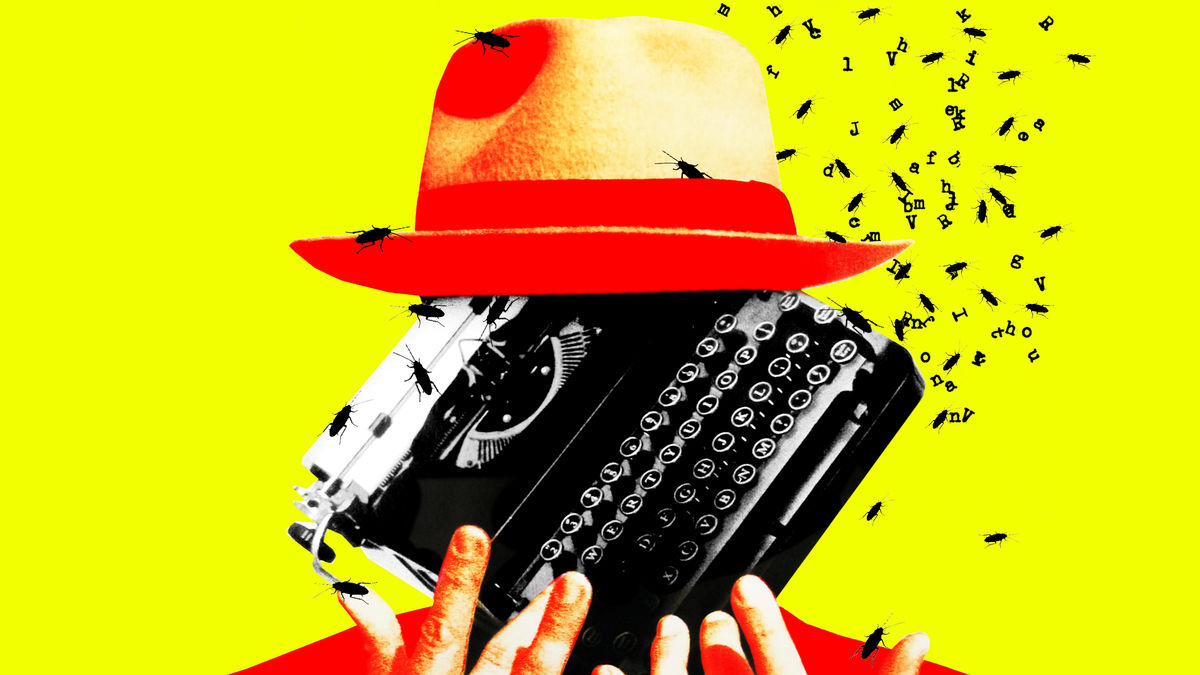
David Cronenberg is demonstrating a typewriter out of every writer’s worst nightmare—a huge fat beetle with legs the size of celery sticks, wings as big as plates, and typewriter keys for teeth. Between the wings is a puckered red fleshy thing that looks just like…
“A talking asshole,” Cronenberg says, quite pleased. “That’s how we do it. Since you could never show a human asshole.”
Of course not. But there had to be a talking asshole. Cronenberg is doing the impossible, filming the unfilmable Naked Lunch. The book by William S. Burroughs was called “a revolting miasma of unrelieved perversion… literary sewage” by a Massachusetts Supreme Court judge in a 1965 obscenity trial, and the good judge wasn’t far off: men sodomize boys as they break their necks, and monsters called Mugwumps secrete an addictive fluid from their penises. When a pregnant woman gets hit by a car and miscarries on the street, the police fine her for a violation of the sanitary code.
With 780,000 copies now in print, Naked Lunch has become the classic American underground novel, a junkie Book of the Dead passed from beatniks to hippies to punks and cheered on by troops of Frenchified academicians who place it in the “transgressive” tradition of Rimbaud, Celine, and Artaud. Burroughs has been lionized as the ultimate id cowboy, a kid from Missouri who was not only gay and a junkie but who shot his wife in the head. You can’t beat that for outlaw credentials.
Cronenberg, of course, is no stranger to outlaw art—Scanners, The Fly, Videodrome, Dead Ringers, The Brood, et al.—and it comes as no surprise that when he was a teenager, Burroughs was one of his favorite writers. “Sometimes a book comes to you at the right time, when what it has to offer is what you want or need,” says Cronenberg. “I think that’s what it did for me.”
Actor Ian Holm (Kafka) is trying to close a door so that the bug crashes into it. “This is an $18,000 bug, so if you hit the door and crush it, it’s your per diem for two days,” jokes Cronenberg, wearing his trademark thick horn-rims, flannel shirt, and jeans. Needless to say, the bug gets full star treatment. A crew member bustles forward to spritz it with methocel, a lubricant that gives it a lifelike slimy gleam. Underneath the floor another member of the crew waits with his hand up the bug’s innards in finger cups that move the asshole’s sphincterlike lips. Six other people work the legs, wings, and other extraneous parts as they watch the results on four monitors. Hey, the thing has a lot of dialogue. It took two days just to place the finger cups and many hours to synchronize the puckering of the sphincter to speech—“I practiced for a month,” says the asshole-puppeteer, Bryan Dewe. It was a lot easier for Dewe to explain to his family: “I just tell ’em I’m the talking butt.”
Here’s the surprise. First you figure, okay, it’s brilliantly written and all, but there’s no getting around the fact that Naked Lunch is dead, reptilian, devoid of all human feeling except the most bitter laughter. It’s one long existential cackle written on an extended nod in Tangier after Burroughs killed his wife while playing an impromptu game of William Tell in Mexico. (At his suggestion, she put a glass on her head and he shot. Low. After thirteen days in jail, he fled Mexico. Later, he discovered that the Mexican authorities had found him guilty of “criminal imprudence” and sentenced him in absentia to two years suspended!) So what you might expect from Cronenberg’s Naked Lunch would be something cynical, grotesque, morbid, bizarre, wildly surrealistic. You won’t be disappointed, but the surprise is that Naked Lunch is the most emotional of Cronenberg’s films. He has been doing riffs on the mad scientist since his earliest student films, but he has gradually deepened his feeling for his characters until the emphasis is on the mad instead of the scientist; he has gone from taxidermy to tragedy.
What Cronenberg heard through Burroughs’s brutal tales was, of all things… a plea. “He felt himself an unattractive person, often desperately lonely,” Cronenberg says. “He would almost deliberately fall hopelessly in love with someone, and he would embark on this kind of masochistic project. He used stand-up routines to make himself attractive, and that’s all very human and recognizable.” The talking asshole has to be balanced, he argues, against the tender Burroughs revealed in books such as Queer and Junkie. “I think he likes to keep that sort of cynical distance, that sarcastic tone that keeps people away. But when you meet him, he has an incredible softness and sweetness.”
Naked Lunch began to become a film when Cronenberg met producer Jeremy Thomas at the Cannes Film Festival in 1983. Thomas is a rarity among movie producers; working out of London, he consistently makes relatively big-budget art films, working with such directors as Bernardo Bertalucci (The Last Emperor) and Nagisa Oshima (Merry Christmas, Mr. Lawrence). Thomas had just seen Videodrome. “I said, ‘What would you like to do?’ ” Thomas recalls, “and he said Naked Lunch. And it was like a flash—it could be a movie.”
Thomas optioned the book and paid development expenses over the next eight years, eventually sinking several hundred thousand dollars into this iffy project. But he renewed the option annually, confident he would end up with what he wanted: “A mainstream film for weirdos.”
It helped that Burroughs told Cronenberg he was the best man for the job. “It was like getting my blessing from the pope, my benediction,” Cronenberg says. “[But] I didn’t know what I was going to do with it. I knew that you couldn’t do the book, for all the obvious reasons. So I had a lot of conversations with Burroughs. I said, ‘I’m not gay, so I don’t know what the sexuality in this movie is going to be like. It’s something that’s got to be dealt with in the movie, but I don’t know how it’s going to come out. Chances are, it’s going to be a lot different from yours.’ ”
Cronenberg finally came up with an idea after finishing Dead Ringers. Rather than try to shoot the book, he mixed Burroughs’s biography and literary imagery with a few sympathetic hallucinations of his own. The “hero” of his script is William Lee (Peter Weller), a strangely stoic man who seems to have given up both writing and drugs to become a solid citizen (an exterminator by trade). Then he finds out that his wife, Joan (Judy Davis), is shooting up so much of his bug powder she only has to breathe on a roach and it falls down dead. “It’s a Kafka high,” she tells him. “It makes you feel like a bug.”
Lee starts taking bug powder himself, and before long a bug-policeman orders him to kill his wife. Lee flees to Interzone, the fictional Tangier of Naked Lunch, where he becomes convinced he’s a spy in the employ of one of the bugs. He starts taking orders from his beetle-typewriter, the Clark-Nova. “I want you to type a few words into me, words that I’ll dictate to you,” it tells him. “First sentence is: Homosexuality is the best all-around cover an agent ever had.”
Lee becomes more more disoriented, taking strange drugs like “the black meat of the aquatic Brazilian centipede” and Mugwump semen (though in the movie the Mugwumps’ penises hang off their foreheads like obscene coxcombs, a nice Cronenbergian touch). Presumably trying to bury his sorrows—among them, the murder of his wife, Joan—he discovers that he can’t. Lee gets involved with Tom and Joan Frost, a couple who bear some resemblance to the writers Paul and Jane Bowles, friends of Burroughs in the Tangier years—only the Jane Bowles character is also played by Judy Davis. “Did you come to Interzone for the boys?” she asks him.
By this time, the film is a thorough mixture of Burroughs and Cronenberg. In fact, to say it’s Burroughs’s Naked Lunch is a bit of a misnomer; the credit should probably read “Cronenburroughs.” “I really feel we got into the telepod together,” the director says happily. (He’s referring to the machine that combines Jeff Goldblum with a fly to make the Brundlefly, in The Fly.) The irony is that Cronenberg, whose highly controlled movies are about the twin dangers of control and losing control, has taken an out-of-control novel and disciplined it, while at the same time unleashing the feelings the novel keeps rigidly in check. Whether it betrays or lives up to Burroughs’s novel will be debated, but it is certainly an attempt Burroughs would recognize: “I live with the constant threat of possession and a constant need to escape from possession, from Control,” he has said. “The death of Joan brought me in contact with the invader, the Ugly Spirit, and maneuvered me into a lifelong struggle, in which I have had no choice but to write my way out.”
Naked Lunch began shooting in a renovated General Electric plant in Toronto just after the Gulf war began in January 1991. Cronenberg had to hastily rewrite the script for a soundstage Tangier, since the insurance company had redlined a location shoot. Today they are shooting Lee’s reaction to the sight of the Sex Blob, an Interzone life-form that Lee finds servicing Joan Frost. As usual, he takes it in stride, like a man in a walking coma.
There are slats in front of the lights casting venetian-blind shadows on the stars’ faces. Weller and Davis look in horror at nothing—imagining the Sex Blob skittering away across the floor. “It’s kind of like an Interzone dog,” Cronenberg says affectionately. “It follows you around and humps your leg.”
Weller was on the set of RoboCop 2 when he learned Cronenberg was going to shoot Naked Lunch. “I jumped up,” recalls Weller, “as well as I could wearing the Robo suit. I said, ‘You’re kidding me.’”
To put it mildly, Weller is a fan of the novel. He breaks into unstoppable stream of consciousness at the slightest provocation. “I’m sitting there in the ’60s, eighteen, nineteen years old, and they’re telling me Vietnam was right, that Guatemala was right, the coup in Chile was right, and then you read Naked Lunch, and it’s this miasma of madness, and I went, ‘Wow, this is horrible,’ but the poetry of it, the visual of it, the anger that it churns out of me about the hypocrisy of the world I was raised into—it disturbed me, man, it provoked me.”
Weller immediately sat down and wrote Cronenberg a letter. “And near the end of it, I said, ‘Well, why even hint? If you haven’t cast the lead, I hereby put in my application.’ ” When Cronenberg did cast him, he turned down a rich offer from Orion to do RoboCop 3. “I wish Orion well,” he says, “but I’ve got other fish to fry.”
Soon Weller was meeting his hero, to whom he bears a strong resemblance. “He said, ‘Your lips are a little thick,’ ” Weller says, laughing. “He’s a wiseass, man.”
Then Weller read the script. “My first reaction was, ‘Wait a minute, it’s not the book.’ But my second reaction was, ‘It’s the spirit of the book. It’s Burroughsian.’ ” Davis was not a Burroughs fan. An Australian who was unfamiliar with the beats and who never took drugs, she didn’t know what to make of Cronenberg’s script. “It was bizarre, very bizarre,” she says. “It took me about six reads before I started to relax with it. Finally David rang me and asked, ‘Have you got any questions?’ And I said, ‘Well, just a couple—like, what is your script about?’”
She is surprised that she was hired. “I was wondering what in anything I’ve done before made them think of me for this, and I just can’t, it’s beyond me.” But Davis is one of the rare actors who can project intelligence; no wonder she’s played writers in My Brilliant Career and Impromptu. On the set, she is almost painfully serious, a dark, depressed presence, which happens to suit her role to a T. Waiting to shoot a scene, she sits in silence as the makeup person touches her up. “Eyelines cleared, please,” she says in a voice curiously toneless, as if she has left her body and is waiting for the character to take over.
“This typewriter is fucked,” she says. “Tom will go crazy.”
Weller answers her in a dead voice. “My Clark-Nova attacked it. Clark-Nova can be pretty vicious when roused to anger.”
They play out the scene, beginning with master shots, then medium shots. It is set in Lee’s pitiful Tangier room, not much more than a stained toilet bowl and a writing table. On the table sits the Clark-Nova. A passage of Burroughs is poised in the roller: “Shooting is a terrible hassle, you have to burn out the alcohol first, then freeze out the camphor and draw this brown liquid off with a dropper….”
When Cronenberg directs, he leans in and speaks softly. “When you need to rehearse some more, you tell me, okay?” he asks. Davis smiles, looking a bit pained. They didn’t rehearse the script at all, to keep things dangerous. “I personally like to be a little bit on the edge,” she says.
As Cronenberg studies the set, he notices a repetition in his dialogue. “He says, ‘Literate, neurotic, complex.’ She says, ‘Madness, disease, suicide.’ It’s like these routines married couples do.”
The script supervisor shoots him a skeptical look. “Yeah, they could have been on The Newlywed Game.”
“You’re off the picture,” Cronenberg shoots back. “I’m trying to be pretentious here, and you’re messing it up.”
Perhaps it’s not so odd that Cronenberg, a family man and virtual teetotaler—“I don’t even like to get drunk,” he says. “I sit there waiting for it to go away”—should have a lifelong fascination with sexual ambivalence and altered states. When Davis signed on, Cronenberg says, she asked him why he was so interested in acts of madness. Did he have some… personal experience? His answer: “I said, ‘What if the film is your act of madness?’ ”
Cronenberg is an atheist, a fatalist, an exile in his own internal Tangier. “What Burroughs is doing is a ripping apart of society,” he says. “He’s not totally wrong.” Critics point to the lingering death of Cronenberg’s parents as the emotional locus for his films (his father had severe ulcers and colitis; his mother, a series of strokes and heart attacks). Asked about it, he is at first surprisingly detached: “I was making these films before my parents died,” he says. “And their deaths didn’t involve the sort of disintegration you could see. I’ve certainly heard of more grotesque deaths.”
Then feeling flashes: “It was grotesque to me because they were my parents, and right until the last minute, their minds were the same minds. And that kind of mind-body split is sort of the horror of it.”
And then Cronenberg makes an odd synthesis: “But a lot of what people respond to in my films as mutilation is really transformation, a different thing. Take The Fly. Think of it as a sort of compressed aging process—it’s someone looking in the mirror and saying, ‘My God, what’s happened to me, I used to be beautiful.’”
What a startling segue—from the death of your parents to this medicinal optimism. But it’s perfectly Cronenbergian; in the laboratory of the heart, every scientist makes the serum for himself. “It’s really [about] coming to terms with the human condition,” he says. “That’s the wound that I’m constantly probing—the giving of consciousness and joy and at the same time the knowledge that it’s finite.”
So think of Naked Lunch as a transformation. More than ever, the Cronenbergian decay has a tragic heft. The existential cackle is muted. Even Cronenberg’s penchant for cold modern architecture has given way to golden browns. “It pleases me to think the defenses are coming down and I’m getting closer to some kind of essence and really allowing the vulnerability to be there. In the earlier films, I had a lot to protect. So, bizarrely enough, even though this film is about the William Burroughs persona, it’s certainly more about me than I’ve ever allowed my film self to be. That’s why I say we’re in the telepod—the film is the telepod. True despair would be not to make it.”
Burroughs saw Cronenberg’s movie at a private screening in Lawrence, Kansas, on November 3, 1991—32 years after his novel was published. “When I started writing,” he said afterward, “I had no idea it could ever be published, let alone made into a film.” But he once imagined his book as a musical, a hipster joke pursued (naturally) by Frank Zappa.
Ironically, Burroughs says he finds Cronenberg’s vision a bit dark even for him. Asked what he thought of some of the ugly gay fantasies, he answers: “I feel that most of Cronenberg’s films have a very dark view of sexuality, whether homo or hetero. If you like Cronenberg, that wouldn’t be a criticism.” And though he does believe writing is dangerous—“as Hemingway said, few survive it”—he’s no longer obsessed with darkness. “I don’t think of myself as negative at all. I believe in life after death.”
How did it feel watching this movie that keeps returning to that awful William Tell scene? Burroughs is unfazed. “It has nothing to do with me personally,” he says briskly. “The whole context is so bizarre, so strange, it was like reading a book.”
Suddenly, apropos of nothing, he blurts out: “That looked like a real goddamn centipede to me in the bathroom. A friend of mine found one six inches long.”
Burroughs says it with relish, savoring the minor horror.
The Stacks is Deadspin’s living archive of great journalism, curated by Bronx Banter’s Alex Belth, who also runs Esquire Classic. Email us at thestacks@deadspin.com.
Related
Britney’s HCL Saga Shows How Murky High Stakes Poker Is
5 Fights the UFC Should Make After Rosas Jr. vs. Barcelos
- MLB Playoff Futures: Three Best Bets for the 2026 Postseason
- Eagles vs. Bears MNF Week 3 Betting Total Picks and Predictions
- Rams vs. Broncos Sunday Night Football Best Betting Pick
- MLB Best Bets: Three Picks for the Final Day of the Regular Season
- UFC Vegas 121 Underdogs: Why Alatengheili Is Worth a Look at +300
- UFC Vegas 121 Predictions: Best Bets for Saturday’s Fight Card
- UFC Vegas 121 Line Movement: Two Betting Favorites Have Completely Flipped